Popular Search Tags on NSFW AI Platforms
Tags are the shortest description of a character that a platform can hand you, and they do more work than any other line on a card. On the trending list a typical entry carries four or five labels, from Unfiltered to Submissive, Fictional, OC and Female, and the same words are reusable as a search query. Combinations, not single labels, are what make a search useful.

Key takeaways
- Read tags as a sentence: one broad label plus one narrow label describes a character far better than either alone.
- The filters Filtered, Unfiltered and 18+ describe content state, not personality, so they combine with labels rather than replacing them.
- Tags travel: the same vocabulary appears in search results and on cards for NSFW AI characters, so a good phrase is reusable.
- Watch conversion, not just reach. One card converts at 0.0526% of its views while another sits at 0.0175%.
Where tag vocabulary comes from
Platforms rarely invent tags for you. They surface what creators already write, which is why the same words recur across cards: Unfiltered, Submissive, Fictional, OC, Female. Treat that list as the shared language between you and everyone building characters, and a query becomes a matter of arranging known words rather than guessing at private ones.
The search page is where the vocabulary becomes interactive. It carries the popular tags in one place, the Filtered, Unfiltered and 18+ states as toggles, a gender filter, and the two leaderboards for creators and characters. A reader who only ever opens the front page sees a fraction of that machinery.
One consequence is worth stating plainly. Because tags are descriptive rather than editorial, a crowded tag says the label is common, not that every card under it suits you. Popularity and fit are separate questions, and the second one is answered by the tag combination you choose.
Reading a tag stack as a sentence
Four labels on a card are close to a sentence: what the character is, how they behave, whether they are fictional or original, and the content state. Put them in that order and you can compare two cards in seconds. A single label is ambiguous on almost every axis; a stack usually is not.
Order matters when you search. Lead with the axis you care about most, because the first condition does most of the filtering, then add one narrowing label. Searching a broad tag first and adding a second condition afterwards keeps the result count workable, whereas starting narrow tends to return an empty page.
Two conditions also keep you honest about what you actually want. Writing the stack out loud forces a decision between, say, a fictional character with an unfamiliar tone and an original character with a familiar one. That is a real choice, and it is easier to make in words than in a feed.
Three ways tag searches go wrong
The first mistake is treating a behaviour label as a genre label. Submissive describes how a character relates to you, not the setting or the story, so it belongs as a second condition rather than as the starting point of a search.
The second is stacking too many labels. Each additional condition multiplies the exclusions, and a five-label query on a catalogue of any size is likely to return nothing at all. If a query comes back empty, the fix is to remove the least important label rather than to scroll the front page instead.
The third is ignoring the content-state filter. The Filtered, Unfiltered and 18+ states change what you are shown at a level below the tags, and an unset filter can flood a well-written query with results you were never going to read. Set the state first, then the vocabulary.
A fourth habit is subtler: assuming a tag means the same thing on every card. Creators write their own descriptions, so a label can drift in emphasis from one card to the next. When two cards carry identical labels and only one of them appeals, the difference is usually in the creator's own summary line, which is worth reading before the tags.
None of these mistakes is fatal, and all four are cheap to fix. The cost of leaving them alone is time: a query that returns forty loosely related cards is slower than one that returns six good ones, even though both took the same second to type.
| Label family | What it selects | When to use it |
|---|---|---|
| Content state | Filtered, Unfiltered and 18+ states | First, before any descriptive tag |
| Relationship tone | Labels such as Submissive | As the second condition in a query |
| Fiction status | Fictional or original character (OC) | When you care about canon versus invention |
| Demographic filter | A gender filter applied to results | When the stack alone returns too many cards |
| Creator credit | The byline attached to the card | To stay inside a style that already works |
Read together, those five families are a query builder. Most disappointing searches are not caused by a missing tag but by conditions applied in the wrong order or by one condition too many.
Worked example: what tag precision is worth
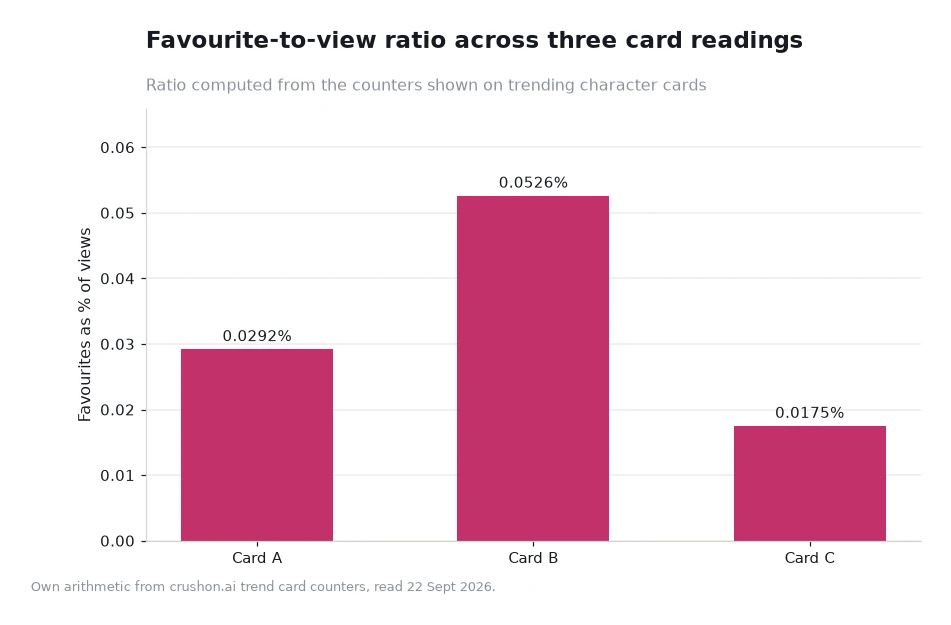
The counters give a way to check whether narrowing pays. Favourites as a share of views: 0.0292% for one card reading, 0.0526% for a second, 0.0175% for a third. The strongest of the three converts at about 1.8 times the rate of the weakest, a gap that no amount of extra reach closes.
Turn the percentages into counts and the difference sharpens. At 0.0292%, 50 favourites implies roughly 171,000 views, since 50 divided by 0.000292 is about 171,233. At 0.0175% the same 50 favourites implies about 286,000 views, because 50 divided by 0.000175 is roughly 285,714. Same outcome, 115,000 more views of exposure in the weaker case.
For a searcher the lesson is that the first label you choose is the expensive decision. A well-chosen stack lands you in the top converting group; a vague one leaves you browsing a group that needs tens of thousands more impressions to produce the same handful of saves.
A routine that uses the vocabulary properly
Set the content state first, add one descriptive label, and keep a note of the phrasing that worked. The character search page gathers the popular tags and the two leaderboards in one place, so the vocabulary stays in front of you while you build the query.
Then compare your notes with the trends side of the platform once a week. The nsfw ai list shows which label combinations are currently attached to cards with strong save rates, and that evidence is a better guide to next week's query than any list of fashionable words.
Frequently asked questions
Are tags written by the platform or by creators?
They are the platform's shared vocabulary for describing creator-built characters, which is why the same labels recur across the trending cards.
Why does a five-tag query return nothing?
Each condition removes results, so five together usually exclude everything. Drop the least important label and search again before giving up on the idea.
Should I rank results by views or by favourites?
Favourites. Views record exposure, while saves record intent, and the save rate separates cards that convert at 0.0526% from cards that convert at 0.0175%.
Learn the language, then use it
Spend one session writing down the labels that appear repeatedly, then treat them as a vocabulary list rather than decoration. Set the content state, choose one descriptive label, add a third condition only if the page is still too long, and record the phrasing that produced a card worth revisiting.
Sources: tag examples, the Filtered, Unfiltered and 18+ filters and the trending counters used for the ratios were read on Crushon on 22 Sept 2026, and the 50-favourite calculations are arithmetic on those percentages.[1] Content intended for adults aged 18 and above.