Fragrance Market Trends: Five Mistakes EU-Bound Buyers Keep Making
Most trend-driven fragrance launches that struggle do not fail because the trend was wrong. They fail because a consumer signal was treated as a decision, because compliance was sequenced after design, or because a quote was compared before the scope was fixed. These five mistakes account for a large share of the delay and rework in EU-bound projects, and each one is avoidable with a document and a deadline rather than with more research.
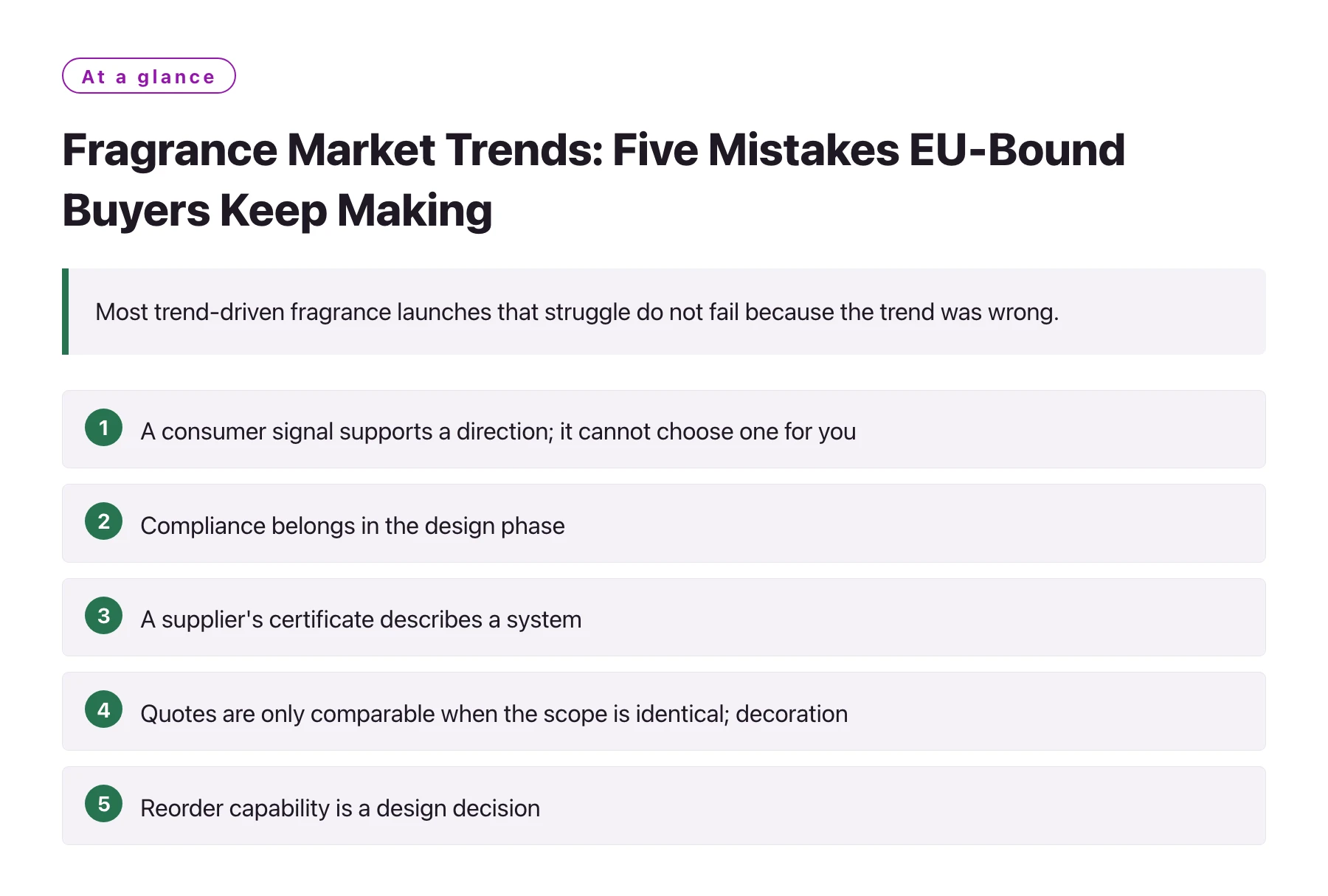
Key takeaways
- A consumer signal supports a direction; it cannot choose one for you, and it certainly cannot set a price point.
- Compliance belongs in the design phase, because ingredient, labelling and packaging rules each change the design in different ways.
- A supplier's certificate describes a system, not the specific product you are placing on the market [4].
- Quotes are only comparable when the scope is identical; decoration, testing and packaging inclusions are where comparisons break down.
- Reorder capability is a design decision, not a logistics detail, and it is cheapest to plan before tooling is committed.
Trade coverage of fragrance tends to celebrate what worked: which note family grew, which format reached a new audience, which positioning found space on the shelf [1]. The failure modes are less discussed and far more repetitive.
Working through launches bound for the European market, the same five mistakes appear again and again. None of them are exotic. Each is a sequencing error, a signal treated as a decision, or an assumption about who is responsible for what.
This piece lists them in the order they usually occur, with the corrective action that prevents each.
Mistake one: the signal becomes the strategy
The first mistake is the fastest to make. A trend report, a retail observation or a competitor's launch becomes the reason for the product, and the brand's own customer is never asked. The result is a line that follows the market and does not fit the people who were going to buy it.
The corrective action is to write the hypothesis down with a disconfirming test attached, as described in any disciplined planning process, and to keep the brand's existing customer in the sentence. Our customer, at this price, will prefer this direction to that one, is a testable claim. The category is growing, is not.
Arriving after the peak
Fragrance development and packaging tooling take months. A direction that is peaking when the brief is written will be crowded by the time the product reaches a shelf, and the crowded version of a trend is the least profitable place to be. The practical response is to use trends to choose how a durable brand idea is expressed now, rather than to choose the idea itself.
Monitoring how quickly the competitive set changes is part of this. Following how newer brands enter and position themselves, for example in commentary on the rise of niche perfume brands, is a cheap way to judge whether a direction is early, current or saturated.
Reading a category chart as your own chart
Category growth figures cover all channels, all price tiers and all buyers. A brand selling through one channel at one price point is a small section of that chart, and the section can move in the opposite direction from the whole. Before adopting a trend, check how comparable products at your price point and channel have performed, not how the category has performed overall.
Mistake two and three: sequencing compliance after design
The next two mistakes are related and both concern timing. The first is designing the pack and the format before checking what the packaging rules require in the destination market. The second is treating the supplier's certificates as the answer to the compliance question instead of as one input among several.
In the European Union, packaging and packaging waste rules have been tightening, and they affect material choices, the fill of the pack and the communication that goes with it [2]. A refill format, chosen for good commercial reasons, can be entirely workable and still require design decisions that are much cheaper to make before tooling than after.
Certificates raise a different confusion. They confirm that a management system has been assessed. They do not confirm that your specific product satisfies the rules of the market it enters, because those rules apply to the finished product, its labelling and its documentation. Regulatory science advice for the European market is produced through a formal committee process precisely because the questions are product-specific [3], which is a useful reminder that compliance is a per-product activity.
What to do instead
Give compliance a seat in the design phase. One working session with the responsible person, the packaging decision and the format options on the table is usually enough to surface the questions that would otherwise appear three months later. Then assign each document to a party in writing: what the manufacturer supplies, what the brand supplies and who files.
The point is not to make the brand an expert in the rules. It is to ensure the questions are asked while they are still cheap, which is the same argument as fixing the brief before sampling.
Mistake four and five: comparing numbers that are not comparable
The fourth mistake is comparing supplier quotes before the scope is fixed. Two perfume quotes that look comparable are usually not: one includes decoration and testing, the other excludes both, one assumes a stock bottle and the other a custom mould. The ranking that comes out of that comparison is an artefact of the inclusions, not a finding about price.
The fifth mistake is leaving the reorder out of the plan. A launch that sells well and cannot be repeated within the selling season has created demand it cannot serve. Reorder speed depends on decisions made at design time: whether components are shared, whether packaging is held in stock, whether the formula and specification are retained by a partner that can produce again without a new development cycle.
Both mistakes have the same corrective action. Fix the scope, then compare quotes line by line against it. And plan the repeat order at the same time as the launch order, including which items will be held and how long a second batch takes.
It also helps to be clear about what the factory is expected to own. A partner set up to run development, filling and packaging as one process can usually answer reorder questions directly, which is what what the global market wants from Chinese perfume manufacturing capacity is often used for: repeatable production at a defined specification rather than one-off development.
A short pre-launch check
Before signing, confirm five things in writing: the scope the price assumes, the documents that travel with the shipment, the retained reference procedure, the deviation process, and the reorder lead time. Each of those five has caused a delayed launch somewhere; none of them costs anything to settle at the contract stage.
Brands that run this check tend to describe their supplier relationships as calm, which is less about personality than about the absence of unresolved questions. Whether the eventual partner is Xuelei perfume factory or another manufacturer, the questions are the same, and the answers are worth having before the money moves.
Every mistake in this list shares one feature: it is a decision made later than it could have been. Trend selection, compliance review, scope definition and reorder planning all cost a fraction as much before sampling as they do after approval. If a launch plan has no dated decision points for those four items, it is not a plan yet.
What a corrected plan looks like
A launch plan that avoids these mistakes is short and specific. It names the customer, states the hypothesis behind the range, fixes the scope before quoting, sequences the compliance questions into design, and includes a reorder assumption with a lead time attached.
For an EU-compliant launch, one line should also name the person who owns the ingredient, labelling and packaging questions, and the documents each party will provide. That single line is what turns the rest of the plan from an intention into something that can be checked at the point where it still matters.
None of that requires more research or a larger team. It requires four dated decisions and one document that both the brand and the manufacturer can read. The trend can still be the starting point; it just stops being the whole argument.
Sources
- Cosmetics Business —— A trade publication covering the beauty and cosmetics industry, including fragrance launches and regulatory developments.
- European Commission: Packaging Waste and the PPWR —— EU rules on packaging and packaging waste, including the Packaging and Packaging Waste Regulation requirements on recyclability and design.
- EU Scientific Committee on Consumer Safety (SCCS) —— The EU scientific committee that issues opinions on the safety of cosmetic ingredients, including fragrance allergens and their labelling thresholds.
- European Commission: Cosmetics in the EU —— The European Commission's overview of EU cosmetics rules, including the responsible person, product information file and safety report requirements.
Frequently asked questions
How can a brand tell whether a trend is already saturated?
Count how many comparable products at your price point and channel have launched in the direction over the last year, and look at how they were priced and discounted. If the direction is well represented and discounting heavily, the opportunity may be in a different expression of the idea rather than the idea itself.
Do EU packaging rules really change product design?
They can, especially for refill and refillable formats, where material choices, pack configuration and the information that accompanies the product all interact. Checking the requirements during design is far cheaper than redesigning after tooling has been ordered.
What does a supplier certificate actually prove?
It confirms that a system has been assessed against a standard. It does not confirm that your product meets the rules of its destination market, because those apply to the finished product, its labelling and its documentation. Treat certificates as one input among several.
How many quotes should be compared at once?
Two or three, provided all of them are built on the same written scope. A larger comparison set is rarely more informative and often means the scope has been kept vague to make the quotes easier to obtain.
What is the cheapest compliance step a small brand can take?
Name one person on each side and record which documents each party provides. The exercise itself surfaces most of the questions that would otherwise arrive late, and it costs a single meeting rather than a consultancy engagement.